
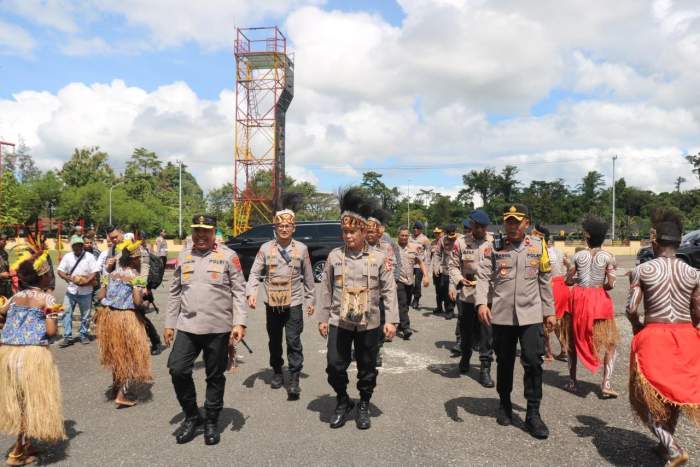
Jayapura – The Assistant for Operations of the Indonesian National Police (Astamaops), Commissioner General of Police Dr. Mohammad Fadil Imran, M.Si., conducted a working visit to several operational areas in Papua together with the Task Force Operation Peace Cartenz 2026 and the Amole Task Force to ensure that the security and public order situation remains safe and conducive.
During the visit, the Astamaops was accompanied by the Head of Peace Operation Cartenz 2026, Inspector General of Police Dr. Faizal Ramadhani, S.Sos., S.I.K., M.H., Head of Operations Development Bureau of the Police Operations Staff Brigadier General of Police Auliansyah Lubis, S.I.K., M.H., Senior Policy Advisor of the National Police Operations Staff Brigadier General of Police Tri Atmodjo Marawasianto, S.I.K., Papua Tengah Regional Police Chief Brigadier General of Police Jermias Rontini, S.I.K., M.Si., Commander of Brimob III Brigadier General of Police John Huntal Sarjananto Sitanggang, S.I.K., M.Han., Head of Operations Planning Division of the Police Operations Staff Cheif Commissioner of Police Karsiman, S.I.K., M.M., as well as senior officials of Task Force Operation Peace Cartenz 2026.
The working visit was carried out to directly assess the latest security developments, inspect the operational readiness of personnel, and ensure that the ongoing operation continues to run effectively in supporting security stability and development throughout Papua.
As part of the agenda, the Astamaops received operational briefings from Task Force Operation Peace Cartenz 2026 and the Amole Task Force regarding the current security situation, measures taken to address security disturbances, operational evaluations, and various community development programs that have been implemented across the operational areas.
In addition to the evaluation, the Astamaops also met with community leaders, traditional leaders, religious figures, and local residents to gain first-hand insight into the social conditions in Papua. According to him, effective communication between security forces and the community is a key element in maintaining long-term security stability in the region.
“We want to observe the situation directly, ensure that public security remains well maintained, and listen to the aspirations of the community. Papua has unique characteristics and strong local wisdom. Therefore, every approach must prioritize dialogue, respect for local culture, and collaboration with all elements of society,” said the Astamaops.
Commissioner General of Police Dr. Mohammad Fadil Imran emphasized that the success of maintaining security in Papua is determined not only by operational readiness and mission accomplishment but also by the ability to safeguard the health and well-being of personnel deployed in the field.
He paid particular attention to the threat of malaria, which remains one of the greatest health risks for personnel serving in several operational areas in Papua. The Astamaops instructed all sector commanders to ensure that preventive measures are implemented consistently, including strict compliance with malaria prophylaxis, the use of mosquito nets and personal protective equipment, and regular medical examinations.
“The greatest threat in the operational area is not only security disturbances but also malaria. I urge every officer to remain disciplined in maintaining their health, strictly follow all preventive measures, and I instruct every commander to closely supervise their personnel. We must not allow our personnel to become victims due to negligence in protecting their health,” he stressed.
According to him, the success of an operation should not only be measured by the achievement of operational objectives but also by the ability of every deployed officer to complete the mission safely and in good health.
Furthermore, the Astamaops instructed that all operational posts continue strengthening force protection, logistical support, healthcare services, and command and control functions. He also emphasized the importance of enhancing collaboration with the Indonesian National Armed Forces (TNI) and all relevant stakeholders to maintain sustainable security stability.
The Astamaops also conveyed the appreciation of the Chief of the Indonesian National Police to all personnel of Task Force Operation Peace Cartenz 2026 and the Amole Task Force for their dedication, loyalty, and commitment in carrying out their duties to safeguard security in Papua. He expressed hope that professionalism, solidarity, and synergy among personnel would continue to be maintained so that the operation could be carried out effectively while providing a greater sense of security for the community.
Meanwhile, the Head of Peace Operation Cartenz 2026, Inspector General of Police Dr. Faizal Ramadhani, S.Sos., S.I.K., M.H., stated that the Astamaops’ visit serves as a strong source of motivation for all personnel to further enhance their professionalism in carrying out their duties.
“The visit of the Astamaops of the Indonesian National Police has become a valuable motivation for all personnel to continuously improve their performance in maintaining security and delivering the best possible service to the community. His directives regarding a humanitarian approach, stronger inter-agency cooperation, and special attention to personnel health—particularly malaria prevention—will serve as important operational guidance in the field. Task Force Operation Peace Cartenz 2026, together with the Amole Task Force, will continue prioritizing preventive and pre-emptive measures, humanitarian engagement, and professional, measured law enforcement in order to create a safe and conducive environment throughout Papua,” said Inspector General of Police Dr. Faizal Ramadhani.
He added that an approach based on local wisdom will remain the primary strategy for strengthening relationships with local communities while ensuring that personnel maintain optimal operational readiness throughout the mission.
Through this working visit, the Indonesian National Police reaffirmed its commitment to maintaining security stability in Papua through professional, humanitarian, and sustainable approaches while ensuring that every deployed officer receives adequate health protection in facing operational challenges. One of the primary priorities remains malaria prevention and control as part of safeguarding the readiness, safety, and overall welfare of personnel serving in the field.
