
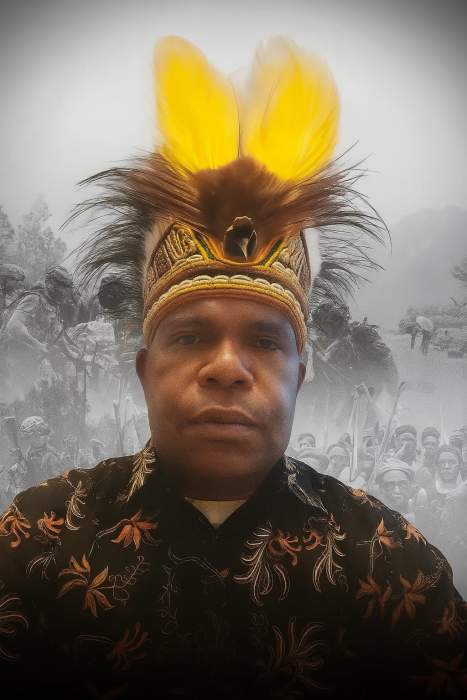
Nabire, Central Papua – The Chairman of the Central Papua People’s Assembly (MRP), Agustinus Anggaibak, S.M., has responded to public discourse surrounding the presence of Indonesian security forces (TNI–Polri) in conflict-prone areas of Papua. He emphasized that the deployment of security personnel is a necessary consequence of ongoing armed conflicts — not a policy that should be hastily blamed on the government.
“We have long discussed the issue of TNI–Polri, both organic and non-organic forces. But we must face the reality that in our regions — particularly in the highlands such as Puncak, Puncak Jaya, Intan Jaya, and around Wamena — armed conflicts have never truly ceased,” Agustinus stated in Nabire on Sunday (October 12).
According to him, the government’s primary duty is to protect its citizens and safeguard national sovereignty. He described the security forces as the “fence” that protects the people.
“When the government deploys TNI and Polri personnel, they act as the nation’s fence. Therefore, as community, religious, youth, and women leaders, we cannot simply blame them or ask, ‘Why are they here?’” he said.
Agustinus stressed that there is a direct correlation between the security situation and the number of personnel deployed in Papua. If peace prevails, the government can reduce troop numbers. However, as long as armed conflict persists, the state is obligated to maintain its presence.
“As long as conflict continues in Papua, the state has the responsibility to deploy security forces to ensure stability,” he affirmed.
He further noted that armed criminal groups (KKB) continue to carry out attacks that result in casualties. Therefore, he said, the government must guarantee the safety of its citizens through the presence of TNI and Polri.
Agustinus also urged all parties to refrain from finger-pointing and instead seek to understand the reasons behind the increased presence of security personnel.
“We should not blame one another. The government must act to protect its people because conflict exists. If there were no gunfire, the government would have no reason to deploy troops,” he concluded.
