
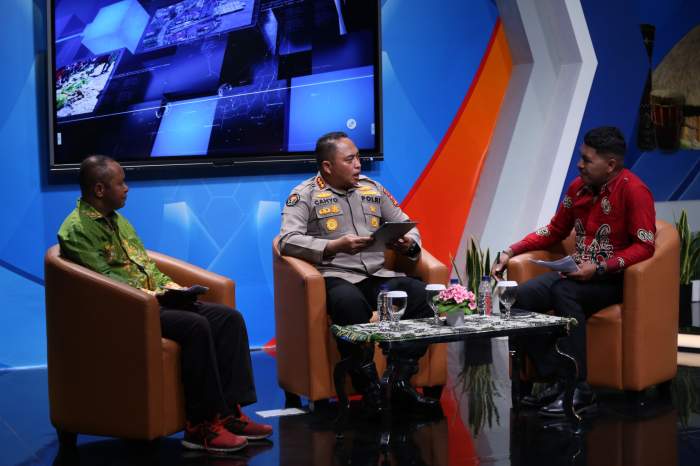
Jayapura, 21 November 2025 — The “Papua 60 Minutes” dialogue program on TVRI Papua highlighted the role of Operation Rasaka Cartenz 2025 in strengthening security stability in Papua. The broadcast featured the Head of Public Relations of the Papua Regional Police, Police Commissioner Cahyo Sukarnito, S.I.K., M.K.P., as the main presenter, alongside Papua academic and community leader Dr. Alfinus Aninam, S.Th., M.Pd.
Commissioner Cahyo outlined that Papua’s security landscape continues to be affected by the activities of armed criminal groups. He emphasized that Operation Rasaka Cartenz prioritizes a human-centered approach through soft-approach strategies, including pre-emptive and preventive measures. These efforts are reinforced by ensuring state basic services reach communities through the Binmas Noken program and digital literacy initiatives designed to mitigate public anxiety triggered by social-media speculation.
He added that understanding local culture remains a fundamental cornerstone of policing operations. The Papua Police have integrated local cultural studies into the curriculum of the Jayapura Police Training School (SPN), mapped community needs, and collaborated with traditional, religious, women, and youth leaders in vulnerable areas. Programs such as KOTEKA, SIIPAR, and KELADISAGU were developed to reach remote regions, particularly in addressing community needs in education and health. Public services have also been strengthened through the 110 Call Center, cyber patrols, the “Dumas Presisi” complaints system, and food-security support programs.
Dr. Alfinus Aninam stated that the humanistic approach applied in Operation Rasaka Cartenz has produced positive outcomes for regional stability and community well-being. He noted that cross-institutional collaboration—spanning universities, churches, and customary institutions—is essential to ensuring sustainable security in Papua. Public education, he said, is equally important to counter misinformation and provocations that could fracture social cohesion.
From a socio-economic perspective, Dr. Alfinus observed that the increasingly stable security conditions have enabled residents to resume daily activities and economic interactions with a greater sense of safety. He added that social and religious collaborations with the Papua Police reflect strong community acceptance of the approaches being implemented.
As the dialogue concluded, both speakers called on the people of Papua to take an active role in maintaining a safe environment. Commissioner Cahyo underscored that public participation is indispensable to building lasting security, while Dr. Alfinus encouraged all societal elements to unite in advancing Papua through strengthened synergy and collaboration.
