
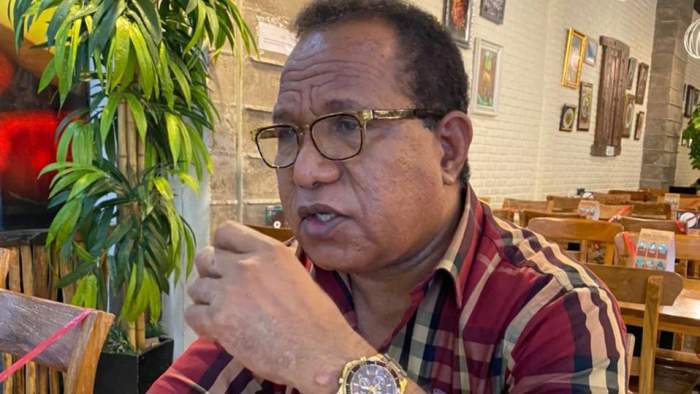
Jakarta — Ahead of December 1, which some groups claim as “Papua Independence Day,” various perspectives have resurfaced among the public. Willem Frans Ansanay, Patron of Barisan Merah Putih and Chairman of Bara JP, emphasized that the annual polemic surrounding December 1 cannot be separated from differing interpretations of history and unresolved welfare issues in Papua.
“December 1 is commemorated by pro-independence groups as the independence day of the Papuan nation, which they believe had already achieved sovereignty before being ‘annexed’ by Indonesia,” Frans told the media on Monday (12/1/25).
According to him, these groups believe that Papua once became a state through the establishment of the so-called “Papua State” by the Dutch, which they use as the basis for their claim that Papua had been independent.
However, Frans stressed that this narrative contradicts Indonesia’s legal standpoint. He explained that since the Trikora mandate on December 19, 1961, and the implementation of the 1969 Act of Free Choice (Pepera), the international community has recognized Papua as a legitimate part of the Unitary State of the Republic of Indonesia (NKRI).
“Pepera 1969 chose Indonesia. Even though it was conducted through a representative model, the decision was legalized and accepted internationally,” he said.
Beyond the historical debate, Frans believes that the root cause behind the persistent calls for “Free Papua” is the inequality in development and natural resource management.
“Papua is rich, but its people are poor. Like mice dying in a rice barn,” he asserted.
He highlighted investment practices that exclude Indigenous Papuans as rightful landowners, along with the domination of resources by certain businessmen and officials who neglect the rights of native communities.
“As long as natural resources are taken without making Papuans shareholders, the movement for Papua independence will continue. This is about livelihoods, not just ideology,” he said.
Frans pointed to one of the most concrete solutions previously proposed by President Joko Widodo: communal land certificates for Indigenous communities. If fully implemented, he said, such a program would give Papuans real bargaining power in major investments.
“If Indigenous communities own shares of their land, they have income. The government only needs to support them—build schools, hospitals, clean water systems, and more,” Frans stated.
He also pushed for equitable development of the Trans-Papua infrastructure and encouraged that executive positions in Papua be filled by Indigenous Papuans in line with the spirit of Special Autonomy.
In fact, he said there should be a dedicated ministry for accelerating development in Papua, not just a temporary team or coordinating body.
Frans also noted that today’s Papuan generation is highly tech-savvy. They can easily access information, create content, and connect with networks abroad.
“Even elementary school kids today can understand the Papua independence issue through videos. Technology has made their movement easier,” he explained.
Therefore, he believes that a security-only approach will not be effective without welfare improvements.
Despite acknowledging significant challenges, Frans urged Papuans to remain calm and avoid provocation every December 1.
“I’m optimistic the state will find a way. But everything must start with welfare. If Papuans are prosperous within Indonesia, they will not demand independence,” he stressed.
Finally, he also highlighted rampant corruption at the local level, which he said worsens the situation.
“Don’t just say Papua must not be independent while allowing corruption to continue. The corruption level in Papua is high, and if we insist Papua should not be independent but do nothing to arrest corrupt officials—who are partly responsible for the suffering—then we are essentially allowing the independence issue to grow. The state must act firmly,” he concluded.
